
API Security in 2026: The Biggest Risk Most Companies Still Ignore
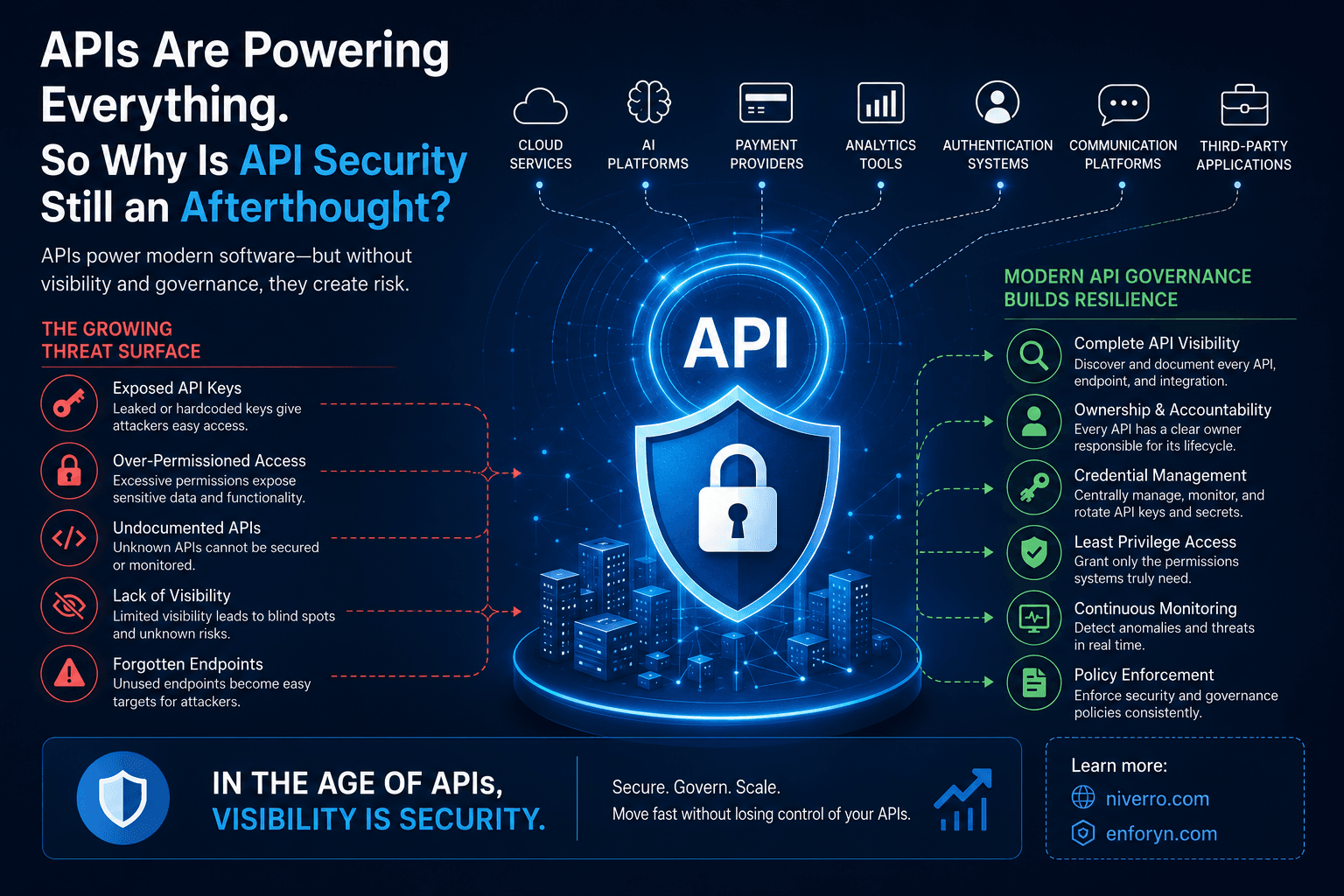
APIs have quietly become the backbone of modern software.
Every mobile app, SaaS platform, AI product, payment gateway, cloud service, and internal application depends on APIs to function. They power customer experiences, automate business operations, and connect entire digital ecosystems.
Yet despite their critical importance, API security remains one of the most overlooked areas in modern software development.
While organizations invest heavily in endpoint protection, firewalls, and infrastructure security, APIs often remain exposed, undocumented, over-permissioned, and poorly governed.
The result is a growing attack surface that many companies don't fully understand.
The API Explosion
Ten years ago, most applications relied primarily on databases and internal services.
Today, a single application may interact with dozens—or even hundreds—of APIs.
Teams integrate:
- Payment providers
- AI platforms
- Cloud services
- Analytics tools
- Authentication systems
- Communication platforms
- Third-party business applications
Every integration introduces new credentials, permissions, endpoints, and security considerations.
As organizations scale, managing these APIs becomes increasingly complex.
The challenge isn't building APIs anymore.
The challenge is securing and governing them.
Why APIs Have Become a Prime Target
Attackers no longer focus solely on traditional vulnerabilities.
They target APIs because APIs often provide direct access to business-critical data and functionality.
A compromised API can expose:
- Customer information
- Financial records
- Internal business data
- Authentication systems
- Administrative functions
In many cases, attackers don't need sophisticated exploits.
Misconfigured permissions, exposed API keys, forgotten endpoints, and poor access controls are often enough.
The most dangerous vulnerabilities are frequently the simplest ones.
The Hidden Problem: API Sprawl
Insert image: API sprawl creates security blind spots as organizations lose visibility into growing numbers of APIs, credentials, and integrations.
Most organizations underestimate how many APIs they actually have.
Development teams move quickly.
New integrations are added.
Microservices are deployed.
Third-party platforms are connected.
Temporary projects become permanent systems.
Over time, organizations lose visibility.
Security teams begin asking questions such as:
- How many APIs do we have?
- Who owns them?
- Which APIs are publicly exposed?
- Which credentials are still active?
- When were keys last rotated?
- Which services are no longer being used?
In many organizations, nobody can confidently answer these questions.
This phenomenon is commonly known as API sprawl.
And API sprawl creates security blind spots.
API Keys: Small Secrets, Massive Consequences
Insert image: Modern attackers increasingly bypass traditional infrastructure defenses and target APIs directly through exposed keys, weak authentication, and forgotten endpoints.
API keys are often treated as implementation details.
Developers generate them.
Applications consume them.
Projects move forward.
But API keys are effectively digital identities.
Anyone possessing a valid key may gain access to systems, services, or sensitive data.
Unfortunately, many organizations still store API keys in:
- Source code repositories
- Shared documents
- Internal chat platforms
- Configuration files
- Developer laptops
Without proper governance, secrets become scattered across the organization.
One leaked credential can quickly become a major incident.
Security Without Governance Doesn't Scale
Many companies focus on securing individual APIs.
Far fewer focus on API governance.
Security and governance are not the same thing.
Security answers:
"Can unauthorized users access this API?"
Governance answers:
"Do we know this API exists, who owns it, what data it exposes, and whether it follows organizational policies?"
As API ecosystems grow, governance becomes just as important as security controls.
Organizations need visibility, ownership tracking, lifecycle management, policy enforcement, and auditing capabilities.
Without governance, security efforts become reactive.
What Modern API Security Looks Like
Insert image: Modern API governance provides complete visibility into APIs, ownership, credentials, risks, and compliance—transforming API security from reactive protection into proactive control.
Modern API security requires more than basic authentication.
Organizations should prioritize:
Complete API Visibility
You cannot secure what you cannot see.
Every API, endpoint, credential, and integration should be discoverable and documented.
Ownership and Accountability
Every API should have a clearly assigned owner responsible for maintenance, compliance, and security.
Credential Management
API keys and secrets should be centrally managed, monitored, and regularly rotated.
Access Control
Permissions should follow the principle of least privilege.
Systems should only have access to what they genuinely require.
Continuous Monitoring
API activity should be continuously monitored for unusual behavior, unauthorized access attempts, and policy violations.
Governance Policies
Security standards should be enforced consistently across the entire API ecosystem rather than relying on manual processes.
The Future of API Security
The rise of AI, cloud-native architectures, microservices, and interconnected platforms will only increase API usage.
Organizations will manage more APIs than ever before.
This growth creates tremendous opportunities—but also significant security challenges.
The companies that succeed will not simply build more APIs.
They will build better systems for governing them.
API security is rapidly evolving from a technical concern into a business requirement.
Customers, partners, and regulators increasingly expect organizations to demonstrate control over their digital infrastructure.
Why We Care About This Problem
At Niverro Technologies, we believe API security and governance will become one of the defining challenges of modern software systems.
That's why we're actively building solutions that help organizations gain visibility, control, and confidence across their API ecosystems.
One of these initiatives is Enforyn, our API security and governance platform designed to help teams understand, manage, and secure their growing API landscape.
Our goal is simple:
Help organizations move fast without losing control of their APIs.
Learn more:
- Niverro Technologies: https://niverro.com
- Enforyn: https://enforyn.com
Final Thoughts
APIs power the modern internet.
But every API added to an organization increases complexity, expands the attack surface, and creates new governance challenges.
The question is no longer whether API security matters.
The question is whether organizations can keep pace with the speed at which their API ecosystems are growing.
The companies that invest in API visibility, governance, and security today will be far better prepared for tomorrow's challenges.
Because in the age of APIs, visibility is security.
Keep reading

The EU AI Act's August 2 Deadline Is Here: Is Your AI Software Actually Compliant?
The EU AI Act is reshaping how businesses build and deploy AI. Learn who it affects, the biggest compliance gaps, and the engineering steps every company should take before regulations tighten.

When Facebook Goes Down, Will AI Still Find Your Business?
Social media outages are a reminder that businesses don't own their audience. Learn why AI search, modern websites, cloud infrastructure, and cybersecurity are becoming the new foundation for customer acquisition in 2026.