
Why We Built Enforyn: The Missing Layer Between Applications and APIs
Modern software runs on APIs.
Whether it's AI models, payment systems, messaging services, cloud infrastructure, or third-party integrations, APIs have become the foundation of nearly every application we build.
At Niverro Technologies, we work extensively with modern software systems, AI applications, and cloud-native products. Over the years, one pattern became impossible to ignore:
Organizations were becoming increasingly dependent on APIs, yet very few had actual control over them.
That realization became the foundation for Enforyn.
The Problem Hidden in Plain Sight
Most development teams think about APIs from an integration perspective.
- How do we connect?
- How do we authenticate?
- How do we send requests?
- How do we handle responses?
But there is another question that often goes unanswered:
What happens after a request leaves the application?
As software becomes increasingly AI-driven, that question becomes more important than ever.
Every API request now carries:
- Financial impact
- Security risks
- Usage implications
- Operational consequences
Yet many organizations still approach APIs as a simple API key management problem.
Store the key. Protect the key. Rotate the key.
Problem solved.
Unfortunately, it isn't.
APIs Became More Powerful. Controls Didn't.
While working with startups, developers, and growing engineering teams, we repeatedly encountered the same issues:
- API keys exposed in frontend applications
- Shared credentials across environments
- Unexpected billing spikes
- No visibility into resource consumption
- Lack of budget controls
- No mechanism to stop misuse before it occurs
Most existing solutions help teams understand what happened.
Very few help prevent the problem from happening in the first place.
This led us to a simple realization:
The industry has monitoring. It has gateways. It has observability.
What it lacks is enforcement.
The Question That Started Enforyn
We began asking ourselves:
What if every API request had to pass through a decision layer before reaching the provider?
A layer capable of answering questions such as:
- Should this request be allowed?
- Is the user authorized?
- Has the project exceeded its budget?
- Is usage behaving abnormally?
- Should the request be rate limited?
- Should it be blocked entirely?
Not after the request.
Before the request.
That idea became Enforyn.
From API Management to API Governance
As we explored the problem further, we realized that most of the industry focuses on API management while overlooking API governance.
API Management focuses on:
- Traffic routing
- Monitoring
- Analytics
- Observability
API Governance focuses on:
- Access control
- Budget enforcement
- Usage policies
- Identity-based permissions
- Compliance and accountability
As AI adoption accelerates, governance becomes increasingly important.
AI systems don't just generate requests.
They generate:
- Costs
- Risks
- Complexity
Organizations need more than visibility. They need control.
Why Existing Solutions Weren't Enough
API gateways excel at routing traffic.
Monitoring platforms provide visibility.
Security tools identify threats.
But modern applications require something different:
Real-time policy decisions.
The ability to evaluate every request against organizational rules before it reaches an external provider.
That missing layer is exactly what Enforyn is designed to provide.
Building Enforyn
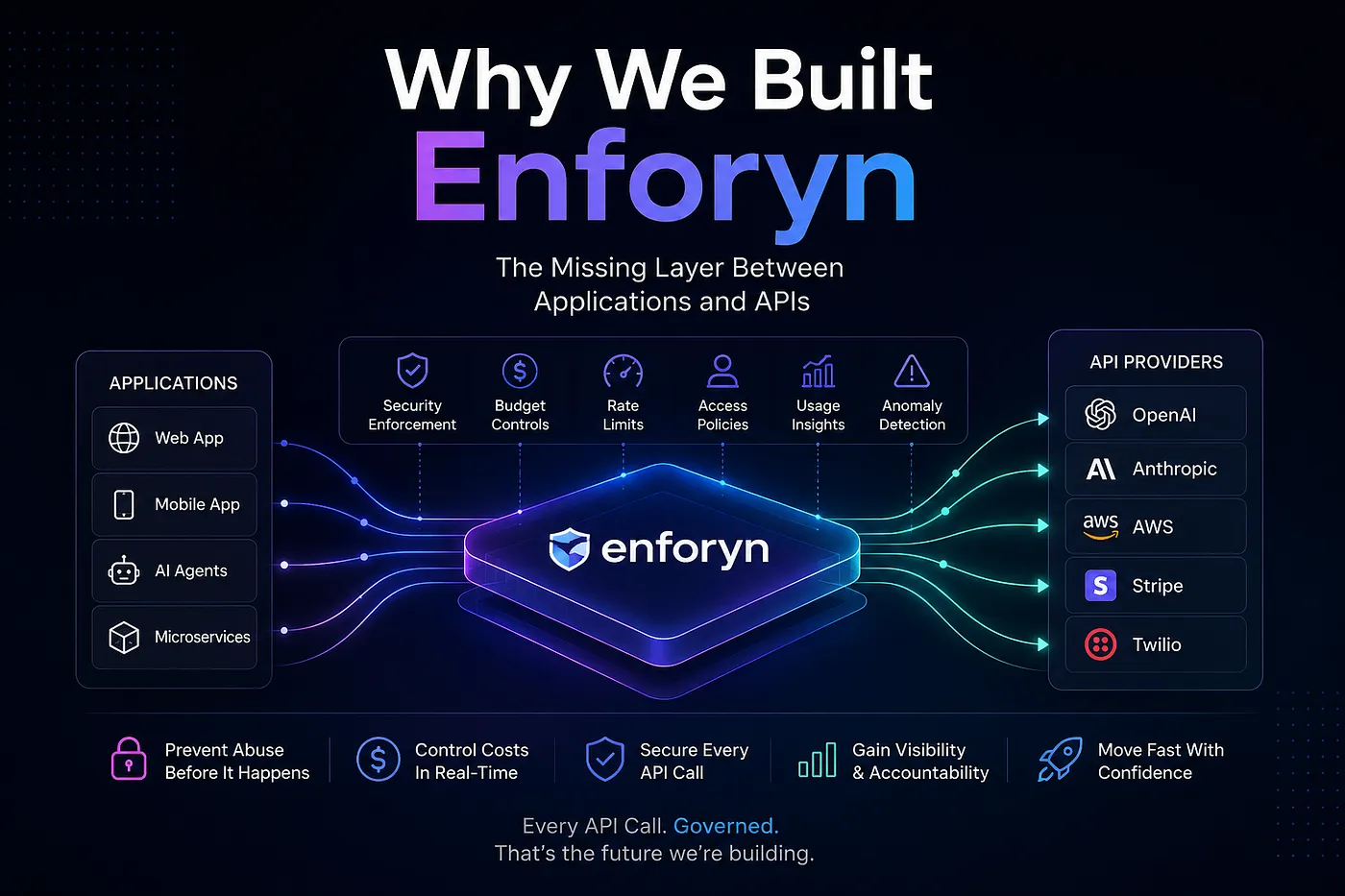
Enforyn sits between applications and API providers.
Application → Enforyn → API Provider
Every request passes through a governance layer capable of enforcing:
- API key isolation
- Usage policies
- Budget controls
- Identity-based access rules
- Rate limiting
- Anomaly detection
- Real-time enforcement decisions
The objective isn't simply visibility.
The objective is control.
Because visibility without control still forces organizations to react instead of prevent.
Who We Built It For
One of the biggest surprises during development was discovering how universal this problem really is.
Solo Developers
Independent builders experimenting with AI APIs need protection from exposed credentials and unexpected costs.
Startups
Growing teams need accountability, usage visibility, and budget management as API consumption increases.
Enterprises
Large organizations require governance, security policies, compliance controls, and operational oversight across multiple teams and systems.
The scale may differ.
The underlying problem remains the same:
Lack of control.
Why This Matters
We believe APIs are becoming one of the most important infrastructure layers in modern software.
Every AI application.
Every SaaS platform.
Every automation workflow.
Every intelligent agent.
They all depend on APIs.
Yet the control layer surrounding those APIs remains surprisingly immature.
Over the next decade, organizations will demand:
- More than access — they will demand governance.
- More than monitoring — they will demand enforcement.
- More than visibility — they will demand control.
Looking Ahead
Enforyn is our contribution to that future.
A future where:
- Every API request is governed.
- Security incidents can be prevented before they happen.
- Teams understand exactly how APIs are being used.
- Budgets are enforced automatically.
- Developers can innovate without sacrificing control.
We're still at the beginning of that journey.
But one thing already feels clear:
The world doesn't need more APIs. It needs better ways to govern them.
And that's why we built Enforyn.
Keep reading

The EU AI Act's August 2 Deadline Is Here: Is Your AI Software Actually Compliant?
The EU AI Act is reshaping how businesses build and deploy AI. Learn who it affects, the biggest compliance gaps, and the engineering steps every company should take before regulations tighten.
When Facebook Goes Down, Will AI Still Find Your Business?
Social media outages are a reminder that businesses don't own their audience. Learn why AI search, modern websites, cloud infrastructure, and cybersecurity are becoming the new foundation for customer acquisition in 2026.